Submarines are some of the most fascinating machines ever built. Designed to travel beneath the ocean’s surface, they can explore depths that humans cannot survive in without special protection. A common question people ask is: how deep can a submarine go? The answer depends on the type of submarine, its purpose, materials, and engineering design.
Some submarines are made for military missions, while others are built for scientific exploration. Each has different depth capabilities. In this article, we’ll explain how deep submarines can travel, what affects their limits, and which submarines hold records for extreme depths.
Understanding Submarine Depth Limits
When asking how deep can a submarine go, it is important to understand that submarines have multiple depth ratings. These include operating depth, test depth, and crush depth.
The operating depth is the normal safe depth where a submarine can function regularly. Test depth is deeper and used during trials to ensure safety margins. Crush depth is the dangerous point where the hull can collapse under water pressure.
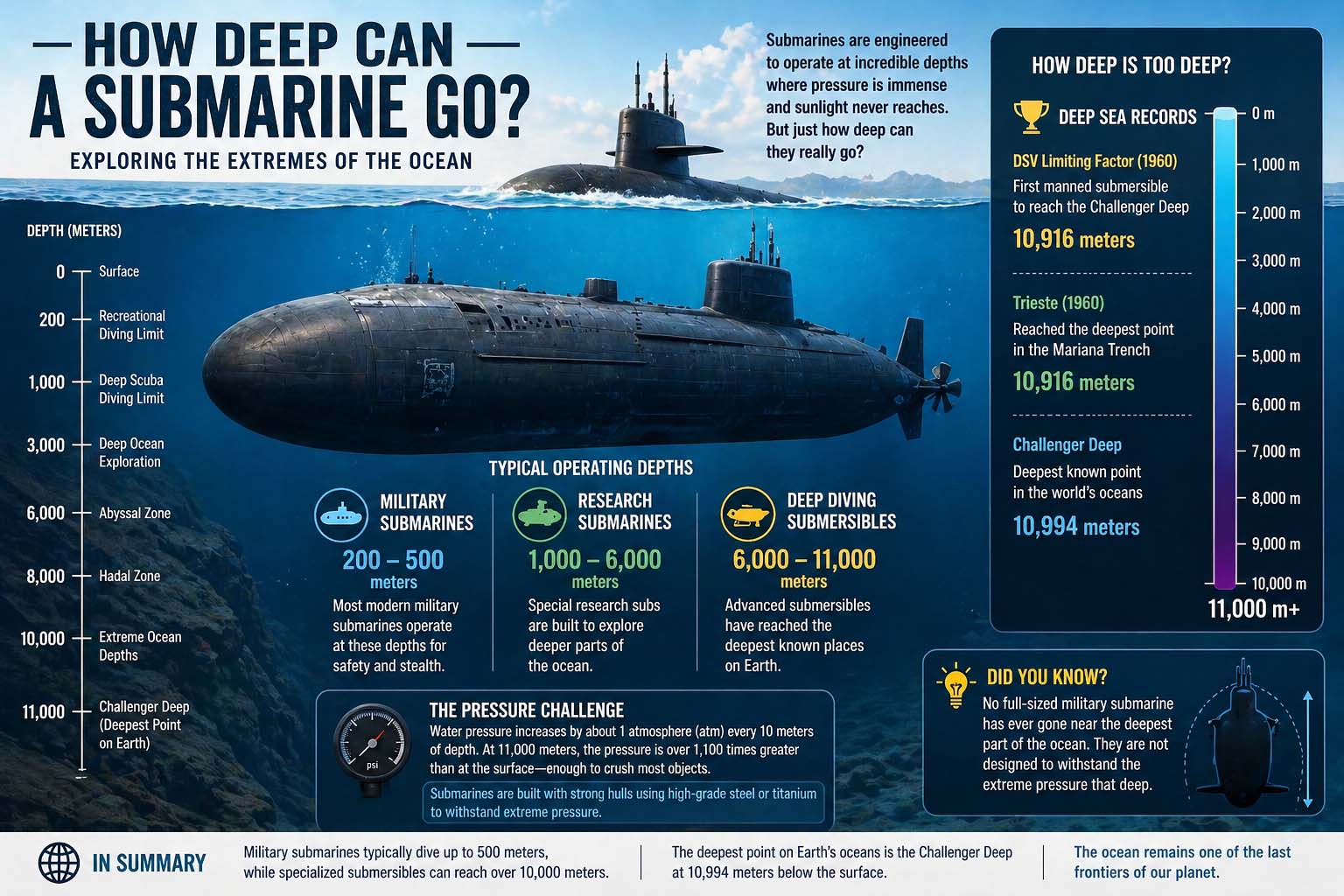
As submarines descend, the pressure increases dramatically. Every 10 meters of depth adds about one atmosphere of pressure. This means a submarine at 300 meters experiences far greater force than one near the surface.
How Deep Military Submarines Can Go
Military submarines are among the strongest underwater vessels. Most modern naval submarines can dive between 200 and 500 meters safely. Exact numbers are often classified for security reasons.
Nuclear-powered submarines operated by countries like United States, Russia, and United Kingdom are designed for deep operations and long missions. Some advanced submarines may exceed 600 meters.
Russian titanium-hull submarines are famous for deeper diving capabilities. Their use of strong lightweight materials allows them to operate deeper than many traditional steel submarines.
So, when people ask how deep can a submarine go, military submarines usually range from 300 to 600 meters depending on design.
How Deep Research Submarines Can Go
Scientific and exploration submarines can go much deeper than military vessels. These submarines are smaller and built specifically for ocean research.
One famous example is DSV Alvin, a research submersible used for decades to study the deep ocean. It can dive thousands of meters below sea level.
Another well-known vessel is Trieste, which reached the deepest known point in the ocean, the Challenger Deep in the Mariana Trench, in 1960.
These special submersibles answer the question how deep can a submarine go with impressive numbers—sometimes over 10,000 meters.
The Deepest Dive Ever Made
The deepest point in Earth’s oceans is the Challenger Deep, located in the Mariana Trench. It reaches nearly 11,000 meters.
In 1960, Jacques Piccard and Don Walsh descended there in the Trieste. Later, filmmaker James Cameron also completed a solo dive to Challenger Deep in the Deepsea Challenger.
These missions show that specially engineered craft can go farther than standard submarines. However, they are not traditional naval submarines.
What Limits How Deep a Submarine Can Go?
Several factors determine how deep can a submarine go:
Hull Material
Submarine hulls are usually made from high-strength steel, titanium, or composite materials. Stronger materials allow deeper dives.
Hull Shape
Round or cylindrical shapes distribute pressure more evenly, helping submarines survive deep water forces.
Size of the Vessel
Smaller submarines can sometimes go deeper because they have less surface area exposed to pressure.
Safety Systems
Advanced sensors and emergency systems are needed to monitor hull stress and avoid disaster.
Why Don’t All Submarines Go Deeper?
If deeper is possible, why don’t all submarines do it? The answer is cost and mission purpose.
Military submarines need speed, stealth, weapons systems, crew space, and endurance. Building them to reach extreme depths would make them more expensive and complex.
Research submarines focus mainly on depth and observation, so they sacrifice size and comfort.
For most missions, submarines do not need to reach the deepest parts of the ocean. Therefore, practical design choices matter more than maximum depth.
Pressure at Extreme Depths
Ocean pressure becomes enormous at great depths. At around 1,000 meters, the pressure is already intense enough to crush unprotected objects. At 11,000 meters in the Mariana Trench, pressure is over 1,000 times the atmospheric pressure at sea level.
This is why submarine engineering is so challenging. Every bolt, seal, window, and weld must handle tremendous force.
Future of Deep Diving Submarines
Technology continues to improve. New materials, robotics, and autonomous underwater vehicles are allowing deeper exploration than ever before.
Some future submarines may travel deeper while carrying more sensors and scientific tools. Human-occupied submersibles will also become safer and more efficient.
As engineers innovate, the answer to how deep can a submarine go may continue to change.
Final Thoughts
So, how deep can a submarine go? Standard military submarines often dive between 300 and 600 meters, while specialized research submersibles can reach over 10,000 meters. The deepest dives have reached the Challenger Deep in the Mariana Trench.
Depth depends on engineering, materials, and purpose. Whether used for defense or science, submarines remain incredible machines that help humans explore one of Earth’s most mysterious environments—the deep ocean.